
Executive Summary
When a customer chooses a 25-year protection and savings plan, they’re not buying a policy - they’re making a life decision. That’s why fully autonomous journeys will be slower to take over here.
But the conversations that lead to those decisions can be transformed immediately.
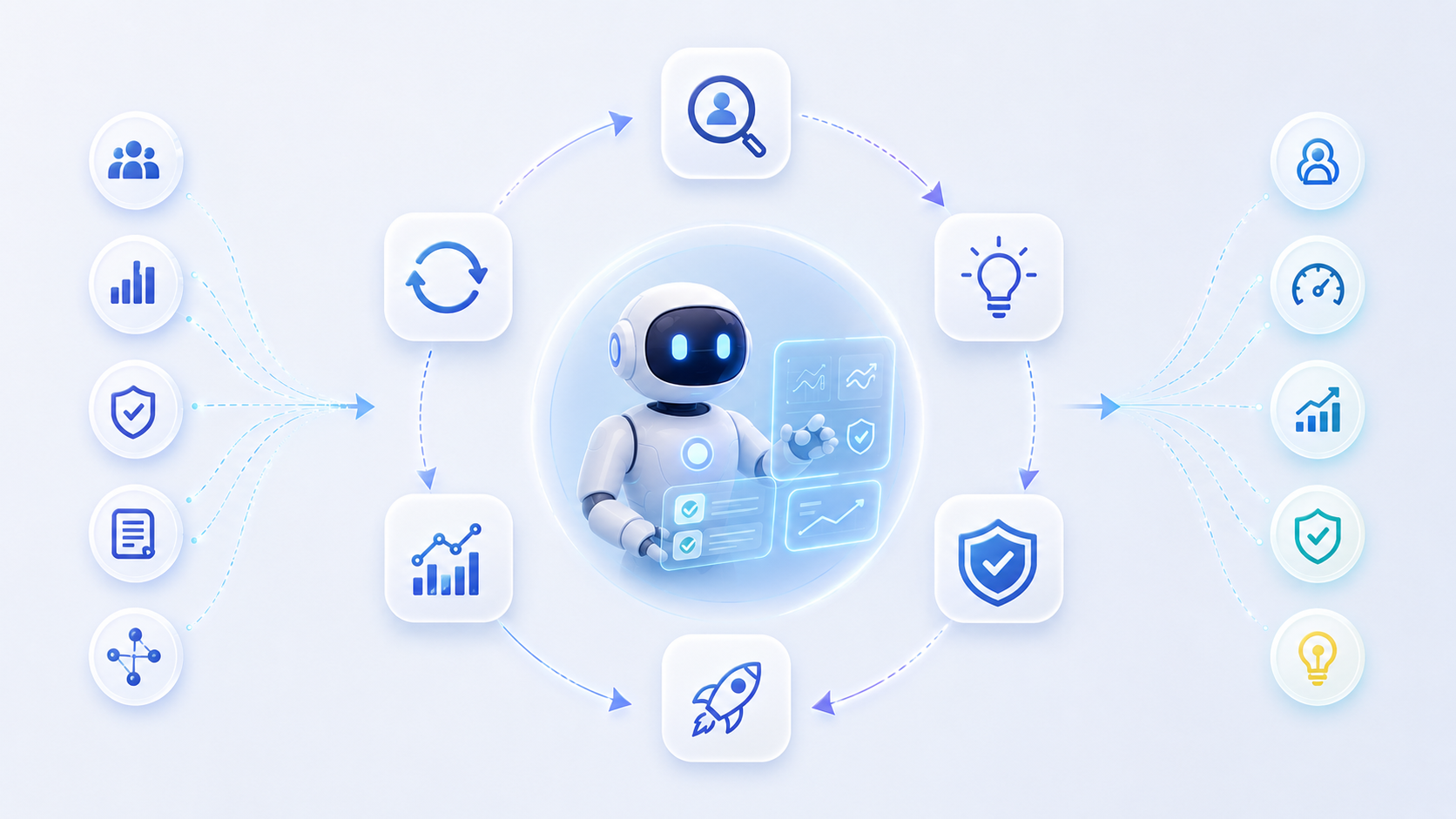
This whitepaper shows how AI can compress weeks of fact-finding, planning and proposal iteration into a single, well-structured meeting, with the advisor still firmly in control of the relationship.
Why Life Advice Won’t Be Fully Automated (Yet)
Big protection and savings decisions are:
- High-stakes: They shape families’ futures for decades.
- Emotionally complex: Guilt, aspiration, fear, family dynamics.
- Regulated: Suitability, documentation, disclosures.
Customers want a human to provide them confidence.
AI’s role is not to replace that moment but to remove everything that dilutes it:
- Manual fact-finding,
- Juggling excel models and illustrations,
- Navigating product complexity mid-conversation.
Designing the AI-Enhanced Advisor Conversation
Imagine an advisor meeting Aisha, a 38-year-old professional with ageing parents and two young children.
Before the meeting, an AI Planning Agent builds a draft view:
- Current income, savings, and commitments
- Existing protection, critical illness and medical covers
- Detected gaps: income continuity, education funding, retirement
During the meeting:
- The advisor uses a tablet to show Aisha 2–3 scenarios:
- “What happens if you stop working at 60?”
- “How does a CI event at 45 change your plan?”
- The AI recalculates instantly, adjusting protection and savings sliders in real time.
- The conversation stays anchored on goals and trade-offs, not on product jargon.
After the meeting, applications, KYC, and suitability documents are pre-drafted for review, saving hours for both advisor and back office.
From Product Push to Outcome-Centric Advice Models
AI also lets insurers rethink how they package life products:
- Rather than pitching “Term + CI + ILP” separately, the AI assembles virtual bundles mapped to goals: “Income Shield”, “Education Track”, “Retirement Floor”.
- Each bundle may contain multiple product elements under the hood, but the customer sees a coherent story.
This supports a pivot in the commercial model:
- Advisors are rewarded for improving customers’ outcome scores (coverage adequacy, risk diversification, plan persistence), not just premium volumes.
- Management dashboards shift from “number of policies” to “percentage of financially resilient customers”.
In a world where AI can simulate countless futures, the carriers that win will be those who measure themselves against the futures they help secure.
Transforming Agency and RM Channels
A practical change program usually involves:
- Pilot with a small advisor/RM cohort focused on a specific segment (e.g., young families, affluent professionals).
- Embed AI tools into their daily workflow - perhaps into the tools they already use.
- Measure shifts in behaviour and outcomes: length and quality of meetings, conversion rates, ticket sizes, customer feedback.
- Scale and standardise the model, including training, supervision, and clear guidelines on when AI can and cannot be used.
The wow moment for distribution heads often comes when mid-performing advisors, given the same AI support as the top performers, start closing gaps dramatically. AI becomes an equaliser, lifting the floor of advice quality across the board.